SAT® Topics
Don't just test. Master the content.
Test Taking Strategy
While there is no substitute for learning the underlying math on the SAT, test-taking strategy can get you very far. So master these fundamentals before going too deep into the underlying content.
The SAT Math section tests your mathematical reasoning skills across many topics.
Basic Strategy
Basic Strategy allows you to answer questions correctly, even if you are a little shaky on the underlying mathematics. Whether you are picking numbers or spamming Desmos, master these essential skills first.
Desmos Skills
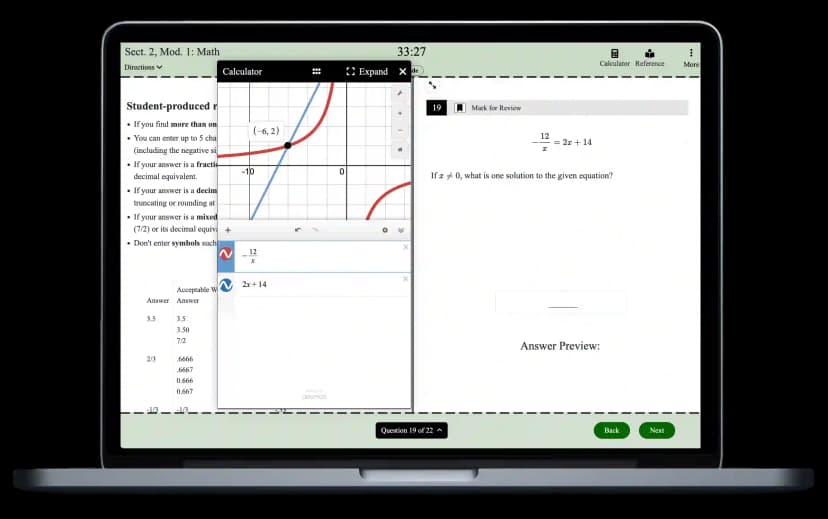
The SAT gives you a built-in Desmos graphing calculator for the whole math section, and plenty of questions get much easier with it. Desmos Skills is about knowing when to graph instead of grinding through algebra: reading intercepts and vertices, finding where two equations meet, checking which expression is equivalent, running a regression from points or a table, finding a mean or median, and using a slider to find the constant that gives no solution. Good habit: type the equation exactly as written, then click the gray dots Desmos puts on intercepts and intersections to read their coordinates instead of eyeballing the grid.
Picking Numbers
When a question is all letters and no numbers, you can often make up your own. That's Picking Numbers: choose easy values that fit the question's conditions, work out the answer as a number, then see which choice gives the same number. It pays off when the answer choices contain variables, when there are more unknowns than equations, when a formula's input gets scaled, when a shape's sides change by a percent, and when percents stack with no starting amount (start with 100). Avoid 0 and 1 when you pick, since they make different expressions match by accident. If two choices both work, try a second set of numbers.
Algebra
Algebra questions test your understanding of linear relationships, systems of equations, and functions. Master these fundamental concepts to solve complex problems effectively.
Lines and Linear Relationships
Lines show up all over SAT math, and nearly every question comes down to two numbers: the slope and the y-intercept. Lines and Linear Relationships asks you to find them from whatever you're given: two points, a table, a graph, or an equation in any form. The biggest group is parallel and perpendicular lines: nonvertical parallel lines have equal slopes, and perpendicular lines with defined slopes have negative reciprocal slopes, so slope $-\frac{2}{3}$ pairs with $\frac{3}{2}$. You'll also match equations to graphs and find intercepts. Shortcut: for $ax + by = c$ with $b \ne 0$, the slope is $-\frac{a}{b}$, no rewriting needed.
Basic Algebra
If $5x=15$, what is $10x+4$? You could find $x=3$ first, or notice that $10x$ is just double $5x$, so the answer is $34$. Basic Algebra is the everyday toolkit behind the rest of SAT math: solving linear equations (parentheses, fractions, decimals and all), combining like terms, and handling fractions and square roots. The SAT's favorite twist is asking for an expression like $x+1$ or $a-b$ instead of the variable itself. When the same chunk shows up more than once, treat it as a single unknown and solve for it directly. It saves steps and dodges the classic slip of answering with $x$ when they wanted $x+1$.
Systems of Equations
Two equations, two unknowns, and usually one pair of values that makes both true at once. That's a system, and the SAT uses them constantly. In Systems of Equations you'll mostly solve a pair of linear equations by substitution or elimination, turn word problems (tickets, mixtures, prices) into two equations, read the solution where two graphed lines cross, and pick which system models a story. Tutor tip: check what the question asks before you solve. If $4a+3b=5$ and $5a+2b=8$ and they want $a-b$, subtract the first equation from the second and you get $3$ without ever finding $a$ or $b$.
Functions
Think of a function as a machine: put in an input, get one output. $f(3)$ just means "put 3 in for $x$." Most Functions questions do exactly that, or run it backward: given $f(x) = 48$, find the $x$ that produces 48. You'll also combine functions, as in $f(x) - g(x)$ or $f(g(2))$, use a known point to find a missing constant, and read values off graphs and tables. The classic trap is mixing up input and output: $f(x) = 48$ means set the expression equal to 48, not plug 48 in. And $f(a) = b$ is just the point $(a, b)$ on the graph.
Infinitely Many and No Solutions
Most linear equations have one answer, but $x + 5 = x + 7$ has none, because no number is 2 more than itself. Infinitely Many and No Solutions is about spotting these special cases. The SAT asks how many solutions an equation or system has, or gives a constant like $k$, says there's no solution, and asks for $k$. Simplify first: matching $x$-terms with different constants means no solution, and identical sides mean infinitely many. With two lines, no solution means parallel (same slope, different intercept), and infinitely many means the same line in disguise, like $x + 2y = 10$ and $3x + 6y = 30$.
Linear Modeling
A taxi charges 3 dollars plus 40 cents per fifth of a mile, and a ride costs 27 dollars. That's 60 fifths of a mile, so 12 miles, not 60. Linear Modeling turns stories like this into equations. Most give a starting value and a constant rate and ask for the equation or a missing number. Others add two items to a total ($ax + by = c$), give two data points, or price the first unit differently. That last one is a classic trap: 52 dollars for the first day and 26 for each extra day is $52 + 26(d - 1)$, not $52 + 26d$.
Linear Inequalities
An inequality like $y > 3x + 4$ doesn't have one answer. It has a whole region of them, and the SAT mostly asks whether a given point lives there. In Linear Inequalities, you'll pick the point that satisfies a system, match a shaded graph to its inequalities, or find the table containing only solutions. Others turn a budget or profit story into an inequality, or ask for the greatest possible coordinate in a solution region. Habit worth keeping: plug answer choices into every inequality in the system, not just the first. And when you multiply or divide by a negative, flip the direction of the inequality.
Direct Translation
"Five less than a number" is $n - 5$, not $5 - n$, and catching flips like that is a big part of Direct Translation, where you turn sentences into math. The most common questions use "per" amounts like people per square mile (per means divide), a starting amount plus a rate times a count (a 30-dollar fee plus 12 dollars a month is $30 + 12m$), and a total split into parts. Some combine two prices, like $1.20j + 3.75g$. Translate one phrase at a time, minding grouping ("twice the sum of $x$ and 3" is $2(x + 3)$) and order in "less than" and "subtracted from."
Solve For Variables In Terms Of Other Variables
Science formulas are written to find one thing, but the SAT often wants a different letter. Solve For Variables In Terms Of Other Variables asks you to rearrange a formula, like turning $V = \frac{M}{D}$ into $D = \frac{M}{V}$ when $V \ne 0$. Many take one step, like dividing both sides. Others hide the target in parentheses, a numerator, a denominator, or inside a square or square root, so you need a few moves. Some want an expression like $d^2$ instead of $d$; treat it as one block and stop early. Habit: undo operations from the outside in, the way you take off a coat before a sweater.
Interpret Variables In Word Problem
A forest starts with 5,000 trees and drops to 200 after $t$ years: $5000 - 120t = 200$. What does 120 mean? The trees lost each year. Picking that meaning is the whole question; no solving needed. Interpret Variables In Word Problem gives you an equation built from a story and asks what one piece represents. Most use a part-plus-part-equals-total equation or a starting value plus a rate; a few ask which part of a geometry formula is, say, the base area. Tip: let the units and the story decide: in $120t$, 120 is trees lost per year, while $120t$ is the total lost over $t$ years.
Inequalities
"At least 35 dollars but no more than 40" is everyday talk for $35 \le C \le 40$, and turning phrases like that into symbols is most of Inequalities. Nearly all are word problems: a fee plus an hourly rate that must stay within a budget, a range with a minimum and a maximum, or two kinds of items (like hours at two jobs) written as $ax + by \le c$. With whole-number answers, check whether the boundary is allowed: at most 4.7 hours gives a maximum of 4, but fewer than 4 hours gives a maximum of 3. And multiplying or dividing by a negative flips the symbol.
Use Given Equation
The SAT often hands you a formula and just wants you to use it correctly: a speed-of-sound equation, a training budget, a parking-lot model. Use Given Equation questions ask you to plug in an input to get the output, work backward from an output to the input, solve for one quantity when you know the other, or find a missing constant from a matching set of values. The science or business behind the formula rarely matters; the algebra does. Common trap: plugging the given value into the wrong letter. Before you substitute, note what each variable stands for and which one the question actually gave you.
Meaning of Slope, Intercepts, or Points
If a gym charges $C = 30m + 50$, the 50 is the sign-up fee and the 30 is what each month adds. Meaning of Slope, Intercepts, or Points is about reading a model like a sentence. The SAT gives you an equation, table or graph and asks what one number means: the starting value, the change per unit, or a point like $f(5) = 265$. Harder ones ask about a change of several units, or the input needed to raise the output by 1. Habit: attach units to each number. If $f(5) = 265$ means 265 miles left after 5 hours, watch for a choice that swaps them.
Points and Equations
If a point lies on a graph, its coordinates make the equation true. That one fact drives Points and Equations: plug in the $x$ and $y$, then solve for whatever is left. Some questions give one point and a missing constant, like $g(x) = n + x^2$ through $(-1, 3)$, so $3 = n + 1$ and $n = 2$. Others take two rounds: find the constant from one point, then use it to get a second point's missing coordinate, or use two points to find two constants. Trap: put negatives in parentheses. $(-1)^2$ is 1, but $-1^2$ in a calculator gives $-1$.
Reducing Or Simplifying Expressions
Simplifying is like tidying a room: nothing new comes in, everything just goes where it belongs. Reducing Or Simplifying Expressions asks which choice is equivalent to a messy expression. The most common style is reducing an algebraic fraction, like $\frac{24x^4}{16x} = \frac{3x^3}{2}$ for $x \ne 0$, sometimes after factoring first. You'll also combine like terms, distribute, and add fractions over a common denominator. Trap: a minus sign in front of parentheses hits every term, so $-(a^3 + 2a^2)$ is $-a^3 - 2a^2$. Backup plan: plug an allowed value like $x = 3$ (no zero denominators) into the original and each choice to cross off the ones that don't match.
Advanced Math
Advanced Math covers complex mathematical concepts including quadratic expressions, exponential growth, and advanced equation solving. These topics require a deeper understanding of mathematical principles.
Quadratics
Graph any quadratic and you get a parabola, a U-shape that can open up or down, and the SAT asks about it from every angle. Quadratics questions fall into a few big families: counting real solutions with the discriminant $b^2-4ac$ (the biggest group), solving (factoring, a square root, or the quadratic formula), finding the vertex or axis of symmetry, matching equations to graphs, and explaining what the numbers mean in a thrown-ball model. A time saver: if a question asks for the sum of the solutions, don't find them. For $ax^2+bx+c=0$ the sum is $-\frac{b}{a}$, and the vertex's $x$-coordinate is half of that.
Interest, Half-Life, and Exponentials
Money earning interest, caffeine leaving your bloodstream, bacteria doubling every 20 minutes: each one multiplies by the same factor over equal stretches of time. Interest, Half-Life, and Exponentials covers the SAT's many questions about models like $P = a(b)^t$. You'll build a model from a percent rate or a half-life, find the starting value (whatever you get at $t = 0$), match an equation to a table or graph, and explain what a number in the model means. Watch the base: losing 7.5% a year means multiplying by 0.925, not 0.075. And an exponent like $\frac{t}{5}$ means the change happens once every 5 time units.
Linear Quadratic Systems
A line can cross a parabola twice, touch it once, or miss it completely, and the SAT likes to ask which. In Linear Quadratic Systems, most questions give a line and a parabola and want an intersection point, or one coordinate of it. Others hide a constant and say the system has exactly one solution. Graphing both in Desmos is often fastest. By hand, substitute the line into the quadratic and move everything to one side; for exactly one solution, set the discriminant $b^2 - 4ac$ equal to zero. If the line is $y = k$ and the system has exactly one solution, $k$ is the vertex's y-value.
Factoring
Factoring is multiplication run backward: $(x+3)(x-2)$ multiplies out to $x^2+x-6$, and factoring takes you from the second form back to the first. On the SAT, Factoring questions most often ask you to pull out a common factor, multiply expressions out, or spot a difference of squares like $a^2-b^2=(a-b)(a+b)$. You'll also match coefficients between two equivalent forms to find a missing constant. Look for a greatest common factor first: $2x^2-18=2(x^2-9)$, and then the difference of squares gives $2(x-3)(x+3)$. Stuck between choices? Plug in a value like $x=3$ (skip 0 and 1, where wrong choices often tie). The right choice gives the same number as the original expression.
Absolute Value
An absolute value is a distance from zero, so $|-7|$ and $|7|$ are both 7. That's why most Absolute Value equations have two solutions: whatever is inside the bars can equal the number or its negative. The SAT usually gives you something like $|5-x|=4$ and asks for one solution, the other one, or the sum or distance between them. You'll also see absolute value functions and equations with the variable outside the bars. A good habit: get the bars alone first, so $4|z-3|=20$ becomes $|z-3|=5$, then split it into $z-3=5$ and $z-3=-5$. And since an absolute value is never negative, $|x-3|=-2$ has no solution.
Exponents
Exponents are shorthand for repeated multiplication, and almost every rule falls out of that: $x^2 \cdot x^3$ is five x's multiplied together, so it's $x^5$. On the SAT, Exponents questions ask you to simplify roots like $\sqrt{16x^{16}}=4x^8$, switch between radicals and fractional powers ($\sqrt[4]{b^3}=b^{3/4}$), and multiply or divide powers of the same base. Some ask you to write one variable as a power of another. A habit worth building: you often don't need the variable itself. If $x^4=3$, then $x^{16}=(x^4)^4=3^4=81$, with no fourth roots required.
Linear vs. Exponential Growth and Decay
Adding the same amount each time gives a straight line; multiplying by the same factor gives a curve that keeps getting steeper (or, for decay, flatter). Linear vs. Exponential Growth and Decay is about telling the two apart from a situation, a table, or a graph. In a table with evenly spaced inputs, equal differences point to a linear model and equal ratios to an exponential one. "Grows 3 inches a month" is linear; "decreases 12% each day" is exponential. The trap: a percent doesn't automatically mean exponential. A tank losing 25% of its original water every 10 minutes loses the same amount each time, so it's linear.
Rational Functions
A rational function is one polynomial divided by another, like $\frac{5x-15}{x+3}$, and its graph has a hole or a vertical asymptote wherever the bottom equals zero. Rational Functions questions on the SAT mostly ask you to find where the graph crosses the axes, pick the graph that fits an equation, or use a given point or shift to pin down a constant. The y-intercept comes from plugging in $x=0$ (here, $-5$). The x-intercepts come from zeros of the numerator, with one trap: if the denominator is also zero there, it isn't an intercept. And a zero of the denominator alone, like $x=1$ in $\frac{(x-4)(x+5)}{x-1}$, never is.
Geometric Sequences
Start with 3, keep multiplying by 2, and you get 3, 6, 12, 24... That's a geometric sequence: each term is the one before it times the same number, called the common ratio. In Geometric Sequences, the SAT asks you to find a term from a short list, write the equation for the nth term, or work a word problem where something doubles or triples every few days. The classic trap is the exponent: the nth term is $a \cdot r^{n-1}$, not $a \cdot r^n$, because the first term hasn't been multiplied yet. And the 92nd term divided by the 90th is just $r^2$, no giant numbers required.
Matching Coefficients
When an equation is true for all values of $x$, both sides are the same polynomial written two ways, so the $x^2$ terms match, the $x$ terms match, and the constants match. Matching Coefficients turns that one equation into several small ones. Most SAT questions have you expand a product like $(x-13)(x+8)$ or distribute and combine like terms; a few use a cubic or a fraction with a remainder. A tutor habit: expand only what you need. If they ask for $b$, the $x$-coefficient, collect just $8x-13x$, so $b=-5$. Then check whether they wanted $b$, $cd$, or $p+q$ before you stop.
Basic Shape of Polynomial Functions
A polynomial's graph is a cheat sheet for its factors. Where the graph crosses the x-axis, the zero has odd multiplicity; where it touches the axis and bounces back, the zero has even multiplicity. Basic Shape of Polynomial Functions questions mostly show a graph and ask which factored equation matches, or give the number of zeros and ask which graph fits. Others use the ends of the graph and the y-intercept. Two quick checks catch most wrong choices: plug $x=0$ into each equation to see if it matches the y-intercept, and check the far right end. If the graph rises there, the leading coefficient is positive.
Problem Solving and Data Analysis
Problem Solving and Data Analysis focuses on quantitative reasoning and interpreting data presented in various formats. Learn to analyze graphs, tables, and statistical data effectively.
Dimensional Analysis and Units Conversion
How fast is 11 miles in 26 minutes, in miles per hour? (About 25.4.) That's this topic in a nutshell: turning one unit into another without losing track. In Dimensional Analysis and Units Conversion, most questions give you one or two conversion factors and ask you to convert a quantity or a rate, or to chain several steps, like rate times time followed by a unit change. Write the units next to every number and cancel them like fractions. Watch area and volume: since 1 yard is 3 feet, 1 square yard is $3^2 = 9$ square feet, not 3.
Line of Best Fit
Real data rarely lines up perfectly, so a Line of Best Fit cuts through the middle of a scatterplot to show the overall trend. The most common SAT question asks which equation could be that line: check the slope's sign first, then its steepness and the y-intercept. You'll also read predictions off the line, estimate its slope, count points above or below it, and compare an actual value with the prediction by subtracting predicted from actual. One habit worth building: read the axis labels before anything else. Gridlines often count by 2s, 5s, or thousands, and axes don't always start at zero.
Probability
If a bag holds 3 red marbles and 7 blue ones, all equally likely, your chance of pulling red is $\frac{3}{10}$: favorable outcomes over all outcomes. On the SAT, Probability nearly always comes down to that one fraction, and the hard part is picking the right total. Some questions are short word problems; most give a two-way table and ask for a plain or conditional probability. A few make you fill in missing counts or work backward from a probability to a count. Tutor tip: words like "given," "of those," or "if a senior is selected" shrink the denominator to one row or column, not the grand total.
Reading Graphs
Plenty of SAT graph questions need no algebra at all. You find the right spot on the axis, read carefully, and you're done. Reading Graphs covers the most common styles: reading one value off a line, curve or bar chart; pulling numbers from a table; picking which graph matches a story (like water filling a glass); and combining two readings into a difference or total. You'll also find intercepts, overall trends and the interval with the greatest change. Tutor tip: check the axis labels and scale before you read anything. A gridline might be worth 5 or 50, and a label like "in thousands" quietly changes the answer.
Frequency Tables
A frequency table is a shortcut: instead of writing 7 six times, it just says "7 appears 6 times." Frequency Tables questions ask you to read tables, histograms and dot plots, then find counts, means and medians. Common styles include finding a possible median from grouped intervals, deciding how the mean and median change when a value (often an outlier) is added or removed, and comparing two distributions. The key habit: keep a running total of the frequencies to find the median's position. With 52 values, the median is the average of the 26th and 27th, wherever those land.
Averages
Most average problems come down to one move: total = mean × count. If 5 games average 25 points, the player scored 125, and that total is what you work with. Averages questions ask you to find the mean of a table or list, compare the means of two data sets, or work backward when the mean involves a variable. You'll also see "what score reaches an average of 85" and combined groups. The classic trap: averaging two group averages works when the groups are the same size, but can go wrong when the sizes differ. To be safe, add up the totals and divide by the total count.
Median, Standard Deviation, Mode, and Range
The average isn't the only way to describe a data set, and the SAT tests the others. Median, Standard Deviation, Mode, and Range covers the middle value, the most common value, the gap from smallest to largest, and how spread out values are around the mean. Expect to find medians from lists, tables, and dot plots, compute ranges, and compare standard deviations: the data set with values more spread out around its mean has the larger one. A favorite twist adds or removes an outlier: check which measures change, since the mean is pulled hard by extremes. Always sort the values before finding a median.
D=RT
Distance equals rate times time, and almost every travel story on the SAT runs on that one equation. D=RT questions often ask for a trip's missing distance, rate or time, with a unit twist like speed in kilometers per hour and time in minutes. Others involve two legs or travelers: write $d = rt$ for each part and connect them. A few use a graph: on a distance-time graph, speed is how steep the line is, whether it rises or falls. Classic trap: ride out at 10 mph and back at 18 mph, and your average speed is not 14. Use total distance divided by total time.
Margin of Error
If a survey says 23% of students see a movie every month, give or take 4%, that "give or take" is the margin of error. Most Margin of Error questions ask what a statement like that really means: the true population percent is plausibly between 19% and 27%, not guaranteed, and it says nothing about any single person. Others compare two surveys (a larger random sample gives a smaller margin of error), turn a range like 40% to 48% into its midpoint and half-width, or convert a percent into a plausible head count. Also check who was sampled: the estimate applies only to the population the sample represents.
Survey Statistics
If 30 of 120 randomly chosen students at your school want a later start time, a fair guess is that about a quarter of the whole school does too. Survey Statistics is about when that kind of leap is allowed. Most questions ask you to scale a sample result up to a population, often using a table. Others ask which conclusion a survey supports, why a survey is biased, which sampling method works best, or how widely the results apply. Tutor tip: check which population the sample represents; a randomized experiment can support a cause-and-effect conclusion, while an observational study generally cannot.
Percents
Sales, tips, taxes, population growth: percents are everywhere, so it's no surprise Percents show up all over the SAT. Most questions ask you to find a percent of a number, figure out what percent one amount is of another, or apply a percent change. The handiest tool is the multiplier: a 15% increase means multiply by 1.15, and a 30% decrease means multiply by 0.70. It also dodges the classic trap. If a jacket costs 60 dollars after a 25% discount, the original price is $60 \div 0.75 = 80$ dollars, not $60 \times 1.25 = 75$.
Box Plots
A box plot squeezes a whole data set into five numbers: minimum, first quartile, median, third quartile, and maximum. Box Plots questions usually hand you two or more plots to compare: whose median is higher, which range is bigger, or which statement must be true. Others ask you to read one plot or match a plot to a bar chart. A box plot usually doesn't tell you the mean or how many values there are, so a "must be true" claim about either is usually a trap. And a long whisker doesn't mean more data; each quarter holds about the same number of values.
Ratios
A ratio of 2 to 5 doesn't tell you how many of anything there are, only that for every 2 of one thing there are 5 of the other. On the SAT, Ratios mostly show up as proportions: you get a ratio and one amount and find the other. You'll also read ratios off tables and graphs, use scales for maps, models and recipes, and split a total into parts. To split a total in a 2 to 5 ratio, add the parts: the bigger share is $\frac{5}{7}$ of the total. Check the order, too: "A to B" is not "B to A."
Geometry and Trigonometry
Geometry and Trigonometry questions test your understanding of shapes, angles, and trigonometric relationships. Master these spatial and measurement concepts to excel in these problem types.
Formulas to Memorize
The SAT gives you a reference sheet of area and volume formulas, so why memorize them? Because flipping to it mid-question eats time, and the sheet won't tell you which formula a word problem needs. Formulas to Memorize covers the regulars: rectangles with sides like $x$ and $x+5$, triangles, circles, boxes, and cylinders, plus surface area and the occasional cone or sphere. Many questions run backward, giving the volume and asking for a radius or height. Classic trap: you're given the diameter, but the formula needs the radius, so halve it before squaring. Surface area isn't on the sheet: add up every exposed surface, curved ones included.
Angles
Most SAT angle questions come down to three numbers: 180° in a triangle, 180° along a straight line, and 360° around a point. In Angles, the most common setup is parallel lines cut by a transversal, where every angle at the two crossings either equals a given angle or adds with it to 180°. You'll also find missing triangle angles, isosceles triangles with equal base angles, and figures that mix parallel lines with a triangle. A handy shortcut: when a side of a triangle is extended, the outside angle equals the two far inside angles added together. And "not drawn to scale" means it, so don't eyeball.
Transformations
Here's the twist everyone trips on: $f(x+3)$ slides a graph 3 units left, not right. Changes inside the parentheses move the graph sideways in the opposite direction from the sign, while changes outside, like $f(x)+3$, move it up or down exactly as written. Transformations questions give you a function and a shift, then ask for the new equation, a zero or point on the moved graph, the new intercept of a translated line, or which graph matches. A good habit: instead of rewriting the whole equation, move one easy point (an intercept or the vertex) and check where it lands.
Similar Triangles and Other Similar Figures
Shrink a photo and everything gets smaller except the angles. That's the idea behind Similar Triangles and Other Similar Figures: same shape, different size, with every length multiplied by the same scale factor. The SAT asks you to find matching angles, scale sides and perimeters, and spot similar triangles hiding in figures: a line parallel to a triangle's base, a "bow tie" of crossing segments, or an altitude dropped inside a right triangle. The classic trap: if lengths are multiplied by $k$, areas are multiplied by $k^2$ and volumes by $k^3$. Triple a square's side and its area grows 9 times, not 3.
Equation of a Circle
Every circle on the coordinate plane fits one pattern, $(x-h)^2+(y-k)^2=r^2$: the center is $(h, k)$ and the radius is $r$. Equation of a Circle asks you to read the center and radius from that form, or build the equation from a center plus a point on the circle (or the two ends of a diameter). If the equation arrives expanded, like $x^2-12x+y^2-10y=-32$, complete the square. Others ask whether a point is inside, on, or outside the circle, or how the equation changes when the circle moves or grows. Two traps: the signs flip, so $(x+6)^2$ means the center's x-coordinate is $-6$, and the right side is $r^2$, not $r$.
SOH-CAH-TOA
Every right triangle comes with three built-in ratios, and SOH-CAH-TOA is the memory trick for them: sine is opposite over hypotenuse, cosine is adjacent over hypotenuse, tangent is opposite over adjacent. The SAT has you read a ratio off a figure, use a ratio and one side to find another side, carry a ratio over to a similar or overlapping triangle, and occasionally go past 90° on the unit circle. Handy fact: one acute angle's sine is the other's cosine, so $\sin 30° = \cos 60°$. Just label "opposite" and "adjacent" from the angle the question names, not the one you happen to be looking at.
Pythagorean Theorem
Walk 3 blocks east and 4 blocks north on a square grid, and you're 5 blocks from your start as the crow flies. That's the Pythagorean Theorem, $a^2 + b^2 = c^2$. On the SAT you'll mostly find a missing side from the other two, sometimes with radicals or expressions in $x$. Often the right triangle hides inside a rectangle, trapezoid or zigzag path, so draw it in. A few questions ask which equation fits the figure. First find the side across from the right angle: that's $c$. Sides of $3x$ and $4x$ give $5x$ only when both are legs; if $4x$ is the hypotenuse, the other leg is $x\sqrt{7}$.
Radians and Degrees
Radians are just another unit for angles, the way inches and centimeters both measure length. The exchange rate to remember is $\pi$ radians $= 180°$. Radians and Degrees questions on the SAT are mostly straight conversions in both directions, like turning $\frac{7\pi}{6}$ into $210°$ or writing $540°$ as $3\pi$. A few ask what fraction of a circle an angle covers, or which angle lands on a given point of the unit circle. To get degrees, multiply by $\frac{180}{\pi}$, and to get radians, multiply by $\frac{\pi}{180}$. When a question writes an angle as $b\pi$ radians and asks for $b$, enter just the coefficient: for $3\pi$, enter 3, not 9.42.
Special Right Triangles
Two right triangles show up so often that the SAT prints them on its reference sheet: the 45-45-90, with sides $x, x, x\sqrt{2}$, and the 30-60-90, with sides $x, x\sqrt{3}, 2x$. Special Right Triangles questions use those ratios in equilateral triangles, hexagons, squares cut along a diagonal, and circles, where a radius often becomes a hypotenuse. The trickier versions hide the triangle until you drop a height in a trapezoid or triangle. Habit worth having: the shortest side is always opposite the 30° angle, and the hypotenuse is exactly twice it. See a $\sqrt{3}$ in a coordinate? Think 30-60-90.
Triangle Congruency
Two triangles are congruent when they are exact copies: same side lengths and same angles, even if one is flipped or turned. Triangle Congruency on the SAT comes in two flavors. Some questions show matching sides or angles and ask which extra fact proves congruence by SSS, SAS, ASA or AAS. Others tell you two triangles are congruent and ask for a missing angle. Watch for AAA (it only proves similarity) and SSA (it can fit two different triangles): neither is enough. And the letter order is the map: $\triangle ABC \cong \triangle DEF$ means $A$ matches $D$, $B$ matches $E$, and $C$ matches $F$.
Diagrams to Memorize
A few SAT figures keep coming back in disguise, and once you recognize one, you know where to start. Diagrams to Memorize collects them: two radii drawn to a chord (secretly an isosceles triangle), a square or triangle inscribed in a circle, a tangent line touching a circle, a picture frame of even width, and oddballs like a box folded from a cut sheet. Two facts do most of the work. A tangent line is always perpendicular to the radius where it touches. A square inscribed in a circle has a diagonal equal to the circle's diameter. Draw in that radius or diagonal before calculating anything.
Parts of Circles
An arc is a piece of a circle's crust, and a sector is a whole slice of the pizza. In Parts of Circles, nearly every question comes down to one proportion: central angle over $360°$ equals arc length over circumference, which equals sector area over total area. The SAT's favorite is arc length: you get two of radius, angle and arc, and find the third. Others ask what fraction of the circle a piece is, or split a circle with diameters. When two radii and a chord form a triangle, it's isosceles, so the central angle is $180°$ minus twice a base angle.
The SAT Trig Identity
Why does $\sin 30^\circ$ equal $\cos 60^\circ$? In a right triangle, the side opposite one acute angle is adjacent to the other, so one angle's sine is its partner's cosine. That's The SAT Trig Identity: $\sin x^\circ = \cos(90^\circ - x^\circ)$. (The "co" in cosine means complement.) The SAT usually gives you the sine of one angle and asks for the cosine of the other, or writes $\sin A = \cos B$ and asks you to solve for an angle or a variable. Tutor tip: when the sine of one acute angle equals the cosine of another, set the angles to add to $90^\circ$, not to equal each other.
Shaded Area and Volume
Most shaded-region questions are two easy area questions in a trench coat: the whole figure, minus the part that isn't shaded. Shaded Area and Volume problems on the SAT put circles inside squares, rings around circles, triangles inside rectangles, and solids inside solids, like a cylinder in a cube or a planet's core inside the planet. Some ask the probability that a random point lands in the shaded part, which is just shaded area over total area. Tip: leave $\pi$ as $\pi$ until the end, since answers often look like $196\pi - 98$ and won't match a decimal.
Inscribed Angle Theorem
Put an angle's vertex on a circle, let both sides cut across the circle, and the angle measures exactly half of the arc it cuts off. That's the Inscribed Angle Theorem. Most SAT questions give you an inscribed angle and ask for its arc, or the reverse, sometimes with a triangle inside. You'll also see $n$ points spaced evenly around a circle, where each gap is $\frac{360}{n}$ degrees, and angles inscribed in a semicircle, which are always $90°$. Watch the direction: going from arc to angle means halve, and going from angle to arc means double. The wrong one is almost always an answer choice.